Author: Sara Fagerlie, PhD, CHCP

  • FDA Closes Out 2025 With 16 Oncology Approvals in Six Weeks

    FDA Closes Out 2025 With 16 Oncology Approvals in Six Weeks

    The US Food and Drug Administration (FDA) closed out 2025 with 16 hematology/oncology approvals in just six weeks, marking one of the most active periods of the year. Issued between early November and mid-December, the decisions spanned hematologic malignancies and solid tumors moving new evidence into clinical practice.

    The approvals covered a wide range of disease settings and mechanisms of action, from CAR T-cell therapy and bispecific antibodies to antibody–drug conjugates, targeted small molecules, and formulation advances. Several actions formalized trends that have been building across major medical meetings, including the continued expansion of immune-based therapies in lymphoid malignancies, growing reliance on molecular selection, and increasing attention to treatment delivery, access, and convenience.

    Hematologic cancers were featured prominently in the regulatory surge. New approvals and label expansions extended options in multiple myeloma, marginal zone lymphoma, follicular lymphoma, chronic lymphocytic leukemia, light chain (AL) amyloidosis, and acute myeloid leukemia, reinforcing the FDA’s ongoing shift toward targeted and immune-based approaches across both indolent and aggressive disease. In several cases, accelerated approvals were converted to traditional approval, signaling regulatory confidence in longer-term efficacy and safety data.

    Solid tumor decisions rounded out the period, with notable activity in breast, bladder, lung, gastric, and prostate cancers. These approvals frequently paired established agents with new settings or combinations, underscoring the agency’s emphasis on biomarker-driven treatment and perioperative strategies, particularly in earlier lines of disease.

    With these approvals in place, the focus now shifts to ensuring that these advances are accessible and used appropriately in everyday practice.

    References:

    U.S. Food and Drug Administration. Oncology (Cancer)/Hematologic Malignancies Approval Notifications. FDA website. Updated 2025. Accessed December 2025. https://www.fda.gov/drugs/resources-information-approved-drugs/oncology-cancerhematologic-malignancies-approval-notifications

  • Oral Menin-Based Triplet Shows Strong Early Activity in ND AML

    The phase II SAVE trial presented at the 2025 American Society of Hematology (ASH) Annual Meeting (Abstract 47) delivered early but compelling results from an all-oral regimen pairing the menin inhibitor revumenib with decitabine/cedazuridine and venetoclax for newly diagnosed acute myeloid leukemia (AML) with mutations in nucleophosmin 1 (NPM1) or rearrangements involving lysine methyltransferase 2A (KMT2A). Among an older, molecularly defined cohort, the combination produced rapid measurable residual disease (MRD)–negative remissions and encouraging early survival signals, raising the possibility that menin inhibition may meaningfully strengthen current low-intensity frontline approaches.

    The newly diagnosed cohort included 21 patients with a median age of 70 years. The NPM1-mutated cohort was older, with a median age of 73 years and 71% aged 70 years or older. Co-mutations were common and included NRAS, KRAS, fms-related tyrosine kinase 3 (FLT3), and isocitrate dehydrogenase 1/2 (IDH1/2). Myelodysplasia-related mutations were present in 43%. Treatment incorporated revumenib through Day 21 of induction to allow confirmation of Day 14 marrow findings before adjustment, and both venetoclax and decitabine/cedazuridine durations were reduced in later cycles as cytopenias emerged. The median cycle length extended to approximately six weeks because of delayed count recovery.

    The overall response rate (ORR) was 86%, and 81% of patients achieved complete remission (CR) or CR with partial hematologic recovery (CRh). All composite remissions were MRD negative by multiparameter flow cytometry with a sensitivity of 10^-4 NPM1-based MRD measured by next-generation sequencing (NGS; sensitivity 5 × 10^-5) showed similar kinetics, and the 2 patients who failed to clear ultimately relapsed. With nine months of median follow-up, the median duration of response (DOR), overall survival (OS), and event-free survival (EFS) had not been reached. Estimated one-year remission rates were 71% in NPM1-mutated AML and 80% in KMT2A-rearranged AML. Most responses occurred within the first cycle, and 33% of patients proceeded to allogeneic hematopoietic stem cell transplantation (HSCT) in first remission, and none of those patients have relapsed.

    Differentiation syndrome (DS) occurred in 19% of patients, including 2 grade 3 events that resolved with corticosteroids. QT interval prolongation occurred in 43% of patients but was limited to grade 2 and did not prompt treatment discontinuation. Infections reflected substantial myelosuppression, with gram-negative rod bacteremia representing the dominant pathogen group. Four deaths occurred including one patient who died post HCT of respiratory failure while receiving revumenib maintenance.

    Taken together, the SAVE trial offers early evidence that integrating a menin inhibitor into an oral hypomethylating agent–venetoclax backbone may produce deep and rapid remissions in newly diagnosed AML with NPM1 mutations or KMT2A rearrangements. Longer follow-up and larger cohorts will be required to define durability, safety in older adults, and the prevalence of resistance mechanisms such as MEN1 mutation.

    References:

    Jen WY, Short NJ, Farhat A, et al. Phase II study of the all-oral combination of revumenib with decitabine/cedazuridine and venetoclax (SAVE) in newly diagnosed AML. Presented at: American Society of Hematology Annual Meeting; 2025; Orlando, FL. Abstract 47.

  • FDA Approves Liso-Cel for R/R MZL

    On December 4, 2025, the US Food and Drug Administration (FDA) approved the CD19/CD3-directed CAR T-cell therapy lisocabtagene maraleucel (Breyanzi) for adult patients with relapsed or refractory marginal zone lymphoma (MZL) who have received 2 or more prior lines of systemic therapy.

    The approval was supported by the MZL cohort of the open-label, multicenter, single-arm phase 2 TRANSCEND FL trial (NCT04245839). A total of 77 patients underwent leukapheresis, and 66 treated patients comprised the primary efficacy analysis set. Patients received a single lisocabtagene maraleucel infusion 2 to 7 days after lymphodepleting chemotherapy.

    The primary endpoint was overall response rate (ORR), assessed per Lugano criteria by an independent review committee. In the intention-to-treat population, the ORR was 84.4% (95% CI, 74.4%–91.7%), including a 55.8% complete response rate (95% CI, 44.1%–67.2%). Median duration of response had not been reached at the time of analysis.

    The safety profile reflected the known adverse-event spectrum of lisocabtagene maraleucel. The prescribing information contains boxed warnings for cytokine release syndrome (CRS) and neurologic toxicities. Additional risks include hypogammaglobulinemia, serious infections, prolonged cytopenias, secondary malignancies, and immune-effector-cell–associated hemophagocytic lymphohistiocytosis–like syndrome.

    References:

    US Food and Drug Administration. FDA approves lisocabtagene maraleucel for relapsed or refractory marginal zone lymphoma. Published December 4, 2025. Accessed December 6, 2025. https://www.fda.gov/drugs/resources-information-approved-drugs/fda-approves-lisocabtagene-maraleucel-relapsed-or-refractory-marginal-zone-lymphoma

  • FDA Approves Epcoritamab with Rituximab and Lenalidomide for R/R FL

    On November 18, 2025, the US Food and Drug Administration approved epcoritamab-bysp in combination with rituximab and lenalidomide for adult patients with relapsed or refractory follicular lymphoma (FL). On the same day, the FDA also converted the prior accelerated approval of epcoritamab-bysp monotherapy in patients with FL who have received at least two prior lines of systemic therapy to full approval.

    The combination approval was supported by data from EPCORE FL-1 (Study M20-638; NCT05409066), a phase 3, open-label, randomized trial enrolling 488 patients with relapsed or refractory FL. Patients were randomized 1:1 to receive epcoritamab-bysp with rituximab and lenalidomide (R²) or R² alone. The coprimary endpoints were progression-free survival (PFS) and overall response rate (ORR) assessed by independent review per Lugano 2014 criteria. ORR was 89% (95% CI, 84–93) in the epcoritamab arm compared to 74% (95% CI, 68–79) in the control arm. Median PFS was not reached in the epcoritamab arm (95% CI, 21.9 months–not reached) and was 11.2 months (95% CI, 10.5–not reached) in the R² arm, corresponding to a hazard ratio of 0.21 (95% CI, 0.13–0.33; P < .0001).

    Treatment-related adverse events included cytokine release syndrome (CRS) in 24% of patients (12% serious) and immune effector cell-associated neurotoxicity syndrome (ICANS) in 0.8%. Serious adverse reactions occurred in 51% of patients, including serious infections in 28%. Common adverse events (≥20%) included injection-site reactions, CRS, fatigue, upper respiratory tract infections, rash, diarrhea, pyrexia, cough, and headache. Grade 3–4 cytopenias included neutropenia (~30%), anemia (~10%), and thrombocytopenia (~8%). Epcoritamab-bysp is administered subcutaneously with a cycle 1 step-up dosing regimen followed by weekly and then every 4-week maintenance dosing.

    This approval offers a fixed-duration, outpatient, chemotherapy-free treatment option for relapsed or refractory FL, a disease marked by inevitable relapse and treatment resistance. The addition of epcoritamab-bysp to R² provides a novel immunotherapeutic strategy with clinically meaningful improvements in PFS and response rates.

    References:

    US Food and Drug Administration. FDA approves epcoritamab-bysp for follicular lymphoma indications. FDA. Published November 18, 2025. Accessed November 18, 2025. https://www.fda.gov/drugs/resources-information-approved-drugs/fda-approves-epcoritamab-bysp-follicular-lymphoma-indications

  • New Interchangeable Pertuzumab Biosimilar Approved for HER2-Positive Breast Cancer

    On November 13, 2025, the US Food and Drug Administration approved pertuzumab-dpzb (Poherdy) as an interchangeable biosimilar to pertuzumab (Perjeta) for the treatment of HER2-positive breast cancer, consistent with the indications of the reference product.

    The approval was based on analytical, nonclinical, and clinical data establishing biosimilarity and interchangeability with the reference product. Evidence included a pharmacokinetic study and a comparative clinical trial in patients with HER2-positive breast cancer, demonstrating no clinically meaningful differences in safety, purity, or potency.

    No new safety signals were observed. The safety profile of pertuzumab-dpzb is expected to reflect that of pertuzumab, with common adverse reactions including diarrhea, alopecia, neutropenia, nausea, fatigue, rash, and peripheral neuropathy. Serious risks include left ventricular dysfunction and infusion-related reactions.

    Pertuzumab-dpzb is the first interchangeable biosimilar to pertuzumab approved in the United States. The interchangeable designation permits pharmacy-level substitution, where state law allows, and may increase access while reducing treatment costs for patients with HER2-positive breast cancer.

    Reference
    US Food and Drug Administration. FDA approves new interchangeable biosimilar to Perjeta. Published November 13, 2025. Accessed November 18, 2025. https://www.fda.gov/drugs/resources-information-approved-drugs/fda-approves-new-interchangeable-biosimilar-perjeta

  • Ziftomenib Approved for NPM1-Mutant R/R AML

    On November 13, 2025, the US Food and Drug Administration approved the menin inhibitor ziftomenib (Komzifti) for adult patients with relapsed or refractory acute myeloid leukemia (AML) harboring a susceptible NPM1 mutation and for whom no satisfactory alternative treatments are available.

    The approval was based on the phase 1/2 KOMET-001 trial (NCT04067336), an open-label, multicenter study enrolling 112 adults with relapsed or refractory AML and confirmed NPM1 mutation. In the phase 2 cohort (n = 92), the primary endpoint was the combined complete remission (CR) and CR with partial hematologic recovery (CRh) rate. Ziftomenib achieved a CR + CRh rate of 21.4% (95% CI, 14.2–30.2), including CR in 17.0% and CRh in 4.5% of patients. Median duration of CR/CRh was 5.0 months (95% CI, 1.9–8.1). Among 66 patients who were transfusion dependent at baseline, 21.2% achieved transfusion independence for at least 56 days; 26.1% of 46 patients who were transfusion independent at baseline maintained that status.

    Adverse reactions included differentiation syndrome (25% overall; 15% grade ≥3), febrile neutropenia (26%), anemia (20%), and thrombocytopenia (20%). QTc prolongation was not clinically significant. Three percent of patients discontinued ziftomenib due to treatment-related adverse events. The prescribing information includes warnings for differentiation syndrome, QTc prolongation, and embryo-fetal toxicity.

    Ziftomenib is the first targeted therapy approved specifically for NPM1-mutant AML, a subset representing approximately 25%–30% of adult AML cases. Responses were observed across subgroups regardless of prior venetoclax exposure or hematopoietic stem cell transplant. “In these heavily pretreated, relapsed/refractory patients, similar response rates were seen … regardless of multiple lines of therapy,” said Dr. Eunice Wang, KOMET-001 investigator (OncLive, November 2023).

    References:

    FDA announcement: https://www.fda.gov/drugs/resources-information-approved-drugs/fda-approves-ziftomenib-relapsed-or-refractory-acute-myeloid-leukemia-npm1-mutation

  • ESMO25: Neoadjuvant T-DXd Combo Tops Anthracycline Standard With Less Toxicity in HER2+ eBC

    At the 2025 European Society for Medical Oncology (ESMO) Congress, Nadia Harbeck, MD, of the University of Munich, presented results of the phase 3 DESTINY-Breast11 trial, marking the first randomized evidence that an antibody–drug conjugate–based neoadjuvant regimen can outperform anthracycline-containing chemotherapy in human epidermal growth factor receptor 2 (HER2)-positive early breast cancer (eBC).

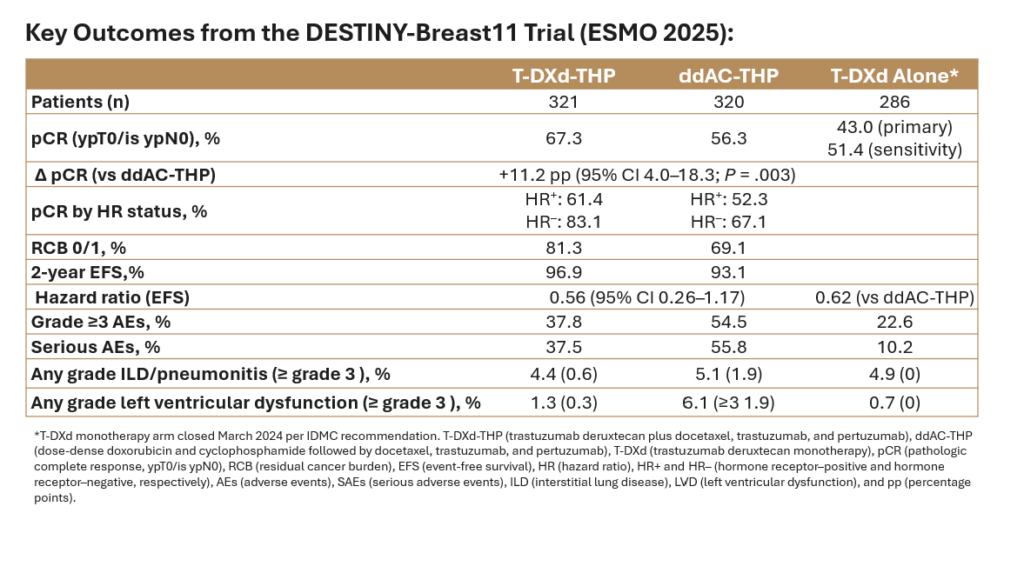
    The global, open-label phase 3 study randomized 927 patients with HER2-positive eBC to receive (1:1:1) trastuzumab deruxtecan plus docetaxel, trastuzumab, and pertuzumab (T-DXd-THP), dose-dense doxorubicin and cyclophosphamide followed by docetaxel, trastuzumab, and pertuzumab (ddAC-THP), or trastuzumab deruxtecan monotherapy (T-DXd). The primary endpoint of the study was pathologic complete response (pCR) by blinded central review, and key secondary endpoints included event-free survival (EFS), invasive disease-free survival (iDFS), overall survival (OS), and safety.

    Median patient age was 50 years, 73% were hormone receptor (HR)–positive, and 89% had node-positive disease.

    The trial met its primary endpoint with T-DXd-THP achieving a pCR rate of 67.3% compared with 56.3% with ddAC-THP, an absolute difference of 11.2 percentage points (95% CI 4.0–18.3; P = .003). The benefit was observed in both HR-positive and HR-negative groups and independent of menopausal or HER2 status (IHC3+ vs other) status.

    Residual cancer burden (RCB) analyses echoed this finding: 81.3% of patients on T-DXd-THP had RCB 0/1, compared with 69.1% in the control arm.

    Event-free survival data were immature at the time of analysis but trended in favor of T-DXd-THP (HR, 0.56; 95% CI, 0.26–1.17). T-DXd monotherapy showed inferior EFS compared to ddAC-THP and was closed on March 13, 2024, as recommended by the independent data monitoring committee.

    Treatment with T-DXd-containing regimens resulted in fewer grade 3 or higher adverse events (AEs), lower hematologic toxicity, fewer treatment interruptions, and less left-ventricular dysfunction. The incidence of interstitial lung disease (ILD) was comparable between arms. T-DXd-THP treatment resulted in higher rates of nausea but were similar for other gastrointestinal toxicities. Adverse events leading to surgical delay occurred in 3.4% of T-DXd-THP patients vs 2.6% of those receiving ddAC-THP.

    Overall, the DESTINY-Breast11study showed that the combination of T-DXd with THP resulted in the highest pCR rates for a registrational trial to date with lower toxicity for patients with HER2+ eBC and may redefine the neoadjuvant standard for high-risk HER2-positive eBC, but longer-term outcomes are awaited. The study was published simultaneously to presentation in the Annals of Oncology.

    References

    Harbeck N, et al. Trastuzumab deruxtecan–based neoadjuvant therapy in high-risk HER2-positive early breast cancer. Abstract 291O, presented at: ESMO 2025 Congress; October 2025; Barcelona, Spain.

    Harbeck N, Modi S, Pusztai L, et al. Neoadjuvant trastuzumab deruxtecan alone or followed by paclitaxel, trastuzumab, and pertuzumab for high-risk HER2-positive early breast cancer (DESTINY-Breast11): a randomised, open-label, multicentre, phase 3 trial.

  • Four-Year Median OS with Osimertinib/ Chemotherapy Combination in Advanced EGFR-Mutation Positive NSCLC

    he final overall survival (OS) analysis from the FLAURA2 trial was presented during the International Association for the Study of Lung Cancer (IASLC) 2025 World Conference on Lung Cancer (WCLC) Presidential Symposium, firmly establishing osimertinib plus chemotherapy as a new first-line standard for patients with advanced epidermal growth factor receptor (EGFR)-mutated non–small cell lung cancer (NSCLC). The final OS analysis showed the longest survival yet reported in this population from a global phase 3 trial.

    FLAURA2 enrolled 557 patients with untreated, locally advanced or metastatic EGFR exon 19 deletion or L858R NSCLC. Patients with stable brain metastases were allowed on study. Participants were randomized to receive osimertinib with carboplatin or cisplatin plus pemetrexed for four cycles followed by maintenance osimertinib–pemetrexed, or osimertinib monotherapy at 80 mg daily. Treatment beyond progression was permitted if investigators judged clinical benefit. Subsequent therapy was at investigator discretion. Progression-free survival (PFS) was the primary endpoint, and OS was a key secondary endpoint.

    At the primary PFS analysis (data cut April 2023), the addition of chemotherapy reduced the risk of progression by 38% (HR 0.62; 95% CI 0.49–0.79; p<0.001), with median PFS of 25.5 months versus 16.7 months for osimertinib alone. These benefits were consistent across prespecified subgroups, including patients with brain metastases and those harboring L858R mutations.

    With extended follow-up to June 2025 (57% maturity), median OS reached 47.5 months in the osimertinib–chemotherapy arm compared with 37.6 months with osimertinib monotherapy (HR 0.77; 95% CI 0.61–0.96; p=0.02). Three-year OS was 63% versus 51%, respectively. The OS advantage was maintained across all predefined subgroups.

    Median osimertinib exposure was 30.5 months with the combination, versus 21.2 months with monotherapy. The median pemetrexed exposure in the experimental arm was 8.3 months, suggesting many patients experienced a prolonged chemotherapy-free interval.

    Patterns of subsequent therapy highlighted clinical practice implications. After progression, platinum-based chemotherapy was the most common second-line treatment in both arms, given to 44% of patients in the combination arm and 72% after osimertinib alone. Importantly, the OS benefit for the upfront combination was preserved despite widespread use of platinum rechallenge after monotherapy.

    Grade ≥3 adverse events (AEs) were more common with the combination (70% vs 34%). Anemia, diarrhea, nausea, and decreased appetite were the most common any-grade AEs.  Adverse events led to discontinuation of osimertinib in 12% of patients in the combination arm and 7% with monotherapy. No new safety signals or treatment-related deaths emerged during longer follow-up.

    These findings build on the FLAURA2 PFS advantage and confirm clinically meaningful OS improvement. Median OS of nearly four years represents the longest survival reported for EGFR-mutated NSCLC in a phase 3 global study. With compelling evidence across subgroups and no excess late toxicity, osimertinib plus chemotherapy is now firmly positioned as the frontline standard of care for EGFR-mutated advanced NSCLC.

    References

    Planchard D, Jänne PA, Kobayashi K, et al. First-line osimertinib plus chemotherapy versus osimertinib monotherapy in EGFR-mutated advanced NSCLC: FLAURA2 final overall survival. Presented at: IASLC World Conference on Lung Cancer (WCLC) 2025; September 7, 2025; Barcelona, Spain. Abstract PL01.06.

  • FDA Approves Sunvozertinib for EGFR Exon 20 Insertion-Positive Metastatic NSCLC

    On July 2, 2025, the U.S. Food and Drug Administration (FDA) granted accelerated approval to sunvozertinib for patients with locally advanced or metastatic non-small cell lung cancer (NSCLC) harboring epidermal growth factor receptor (EGFR) exon 20 insertion mutations, (as detected by an FDA-approved test), whose disease has progressed on or after platinum-based chemotherapy.

    Sunvozertinib is an oral EGFR tyrosine kinase inhibitor. The approval was based on the phase WU-KONG6 multicenter study evaluating sunvozertinib monotherapy in patients with previously treated EGFR exon 20 insertion–positive NSCLC. The objective response rate was 46% with a median duration of response of 11.1 months.

    US Food and Drug website. Available at: https://www.fda.gov/drugs/resources-information-approved-drugs/fda-grants-accelerated-approval-sunvozertinib-metastatic-non-small-cell-lung-cancer-egfr-exon-20. Accessed July 9, 2025.