
Category: Oncology

  • ASCO GU 2026: Perioperative EV/Pembrolizumab Outperforms Gemcitabine/Cisplatin in MIBC

    At the 2026 ASCO Genitourinary Cancers Symposium, Matthew D. Galsky, MD, presented results from the phase 3 KEYNOTE-B15 study showing that perioperative enfortumab vedotin plus pembrolizumab improved outcomes over neoadjuvant gemcitabine plus cisplatin in cisplatin-eligible muscle-invasive bladder cancer (MIBC). The findings are notable because cisplatin-based neoadjuvant chemotherapy has remained the standard of care for eligible patients with MIBC for decades, and KEYNOTE-B15 is the first phase 3 trial to show superior outcomes with a non-platinum perioperative regimen.

    KEYNOTE-B15 enrolled patients with clinically localized muscle-invasive urothelial carcinoma of the bladder who were eligible for cisplatin-based chemotherapy and radical cystectomy. Patients were randomly assigned 1:1 to 4 cycles of neoadjuvant enfortumab vedotin plus pembrolizumab followed by cystectomy and adjuvant pembrolizumab, with the first 5 adjuvant cycles given with enfortumab vedotin, or to 4 cycles of neoadjuvant gemcitabine plus cisplatin followed by cystectomy and observation. Randomization was stratified by PD-L1 status, clinical stage, and geographic region. The primary endpoint was blinded independent central review–assessed event-free survival (EFS), with overall survival (OS) and pathologic complete response (pCR) among the key secondary endpoints.

    A total of 808 patients were randomized between May 2021 and December 2023. With a median follow-up of 33.6 months, EFS was significantly improved with enfortumab vedotin plus pembrolizumab. Median EFS was not reached in the experimental arm vs 48.5 months with gemcitabine plus cisplatin (hazard ratio [HR], 0.53; 95% CI, 0.41-0.70; 1-sided P<.0001). The 24-month EFS rates were 79.4% and 66.2%, respectively. OS also favored enfortumab vedotin plus pembrolizumab (HR, 0.65; 95% CI, 0.48-0.89; 1-sided P=.0029). Median OS was not reached in either arm, and the 24-month OS rates were 86.9% with enfortumab vedotin plus pembrolizumab and 81.3% with gemcitabine plus cisplatin.

    Pathologic complete response rates were higher with the perioperative enfortumab vedotin/pembrolizumab approach. In the intent-to-treat population, centrally assessed pCR was 55.8% with enfortumab vedotin plus pembrolizumab vs 32.5% with gemcitabine plus cisplatin, for an estimated difference of 23.4% (95% CI, 16.7-29.8; 1-sided P<.0001). In the presentation, Galsky noted that among patients who underwent cystectomy, the pCR rate in the enfortumab vedotin plus pembrolizumab arm was 64.4%. The ability to proceed to surgery was similar between arms, at 87% with enfortumab vedotin plus pembrolizumab and 90% with gemcitabine plus cisplatin.

    Safety was consistent with the known profiles of the regimens. Treatment exposure was longer in the enfortumab vedotin plus pembrolizumab arm. Grade 3 or higher treatment-emergent adverse events occurred in 75.7% of patients receiving enfortumab vedotin plus pembrolizumab and 67.2% of those receiving gemcitabine plus cisplatin. The most common grade 3 or higher drug-related adverse event of special interest with enfortumab vedotin was skin reactions.

    Overall, in a cisplatin-eligible population that has long been treated with cisplatin-based perioperative therapy, KEYNOTE-B15 showed improvements in EFS, OS, and pCR with enfortumab vedotin plus pembrolizumab. Together with prior positive perioperative data in cisplatin-ineligible disease, the study supports enfortumab vedotin plus pembrolizumab as a new treatment option across a broader MIBC population.

    References

    1. Galsky MD, Balar AV, Maruzzo M, et al. Neoadjuvant and adjuvant enfortumab vedotin plus pembrolizumab for patients with muscle-invasive bladder cancer who are eligible for cisplatin-based chemotherapy: randomized, open-label, phase 3 KEYNOTE-B15 study. Presented at: 2026 ASCO Genitourinary Cancers Symposium; February 2026; San Francisco, CA. Abstract LBA630.

  • ASCO GI 2026: Encorafenib/Cetuximab Plus FOLFIRI Improves Response in BRAF V600E CRC

    ASCO GI 2026: Encorafenib/Cetuximab Plus FOLFIRI Improves Response in BRAF V600E CRC

    At the 2026 Gastrointestinal Cancers Symposium, BREAKWATER Cohort 3 delivered the clearest signal yet that encorafenib plus cetuximab can be paired with FOLFIRI (folinic acid [leucovorin], fluorouracil [5‑FU] and irinotecan) in the first-line treatment of BRAF V600E-mutant metastatic colorectal cancer. In the oral presentation, Scott Kopetz, MD, reported a statistically significant improvement in objective response rate with the targeted regimen plus chemotherapy over standard FOLFIRI with or without bevacizumab, with an early overall survival trend that also favored the experimental arm.

    The phase 3, open-label BREAKWATER study has already established the activity of encorafenib and cetuximab with an oxaliplatin backbone. Cohort 3 asked whether the same targeted approach could work with FOLFIRI for patients who are not ideal candidates for oxaliplatin, including those with prior exposure in the adjuvant setting or baseline neuropathy. This cohort enrolled previously untreated patients with microsatellite-stable, BRAF V600E-mutant metastatic colorectal cancer and ECOG performance status 0 or 1. Patients were randomly assigned 1:1 to encorafenib plus cetuximab and FOLFIRI or to control FOLFIRI with or without bevacizumab. The primary endpoint was objective response rate by blinded independent central review. Progression-free survival was the key secondary endpoint, with overall survival, duration of response, and safety among the additional secondary endpoints.

    The confirmed objective response rate was 64% with encorafenib, cetuximab, and FOLFIRI compared with 39% in the control arm, meeting the primary endpoint (one-sided P value, .0011; odds ratio, 2.8). Median follow-up was just over 10 months. Median overall survival was not estimable in either arm, but the reported hazard ratio for overall survival was 0.49, favoring the targeted triplet. Progression-free survival follow-up is ongoing and has not yet been reported for this cohort.

    No new safety signals emerged, with adverse events consistent with those expected for each study drug. Grade 3 or 4 treatment-related adverse events occurred in 63% of patients on the experimental arm and 71% of patients in the control group. Serious treatment-emergent adverse events were reported in 39% of patients treated with encorafenib, cetuximab, and FOLFIRI and in 37% of those in the control arm. Treatment-emergent adverse events leading to permanent discontinuation of any study treatment was 11% in the encorafenib-containing arm and 9% in the control arm. Skin hyperpigmentation, dry skin, asthenia, weight decrease, arthralgia, palmar-plantar erythrodysesthesia, and rash appeared to occur more commonly on the encorafenib-containing arm.

    Overall, these data are encouraging, especially for patients where oxaliplatin is not an ideal fit, but longer follow-up is needed.

    References

    Kopetz S, Wasan HS, Yoshino T, et al. BREAKWATER: Primary analysis of first-line encorafenib plus cetuximab plus FOLFIRI in BRAF V600E-mutant metastatic colorectal cancer. Presented at: Gastrointestinal Cancers Symposium; 2026. Abstract 13.

  • New Interchangeable Pertuzumab Biosimilar Approved for HER2-Positive Breast Cancer

    On November 13, 2025, the US Food and Drug Administration approved pertuzumab-dpzb (Poherdy) as an interchangeable biosimilar to pertuzumab (Perjeta) for the treatment of HER2-positive breast cancer, consistent with the indications of the reference product.

    The approval was based on analytical, nonclinical, and clinical data establishing biosimilarity and interchangeability with the reference product. Evidence included a pharmacokinetic study and a comparative clinical trial in patients with HER2-positive breast cancer, demonstrating no clinically meaningful differences in safety, purity, or potency.

    No new safety signals were observed. The safety profile of pertuzumab-dpzb is expected to reflect that of pertuzumab, with common adverse reactions including diarrhea, alopecia, neutropenia, nausea, fatigue, rash, and peripheral neuropathy. Serious risks include left ventricular dysfunction and infusion-related reactions.

    Pertuzumab-dpzb is the first interchangeable biosimilar to pertuzumab approved in the United States. The interchangeable designation permits pharmacy-level substitution, where state law allows, and may increase access while reducing treatment costs for patients with HER2-positive breast cancer.

    Reference
    US Food and Drug Administration. FDA approves new interchangeable biosimilar to Perjeta. Published November 13, 2025. Accessed November 18, 2025. https://www.fda.gov/drugs/resources-information-approved-drugs/fda-approves-new-interchangeable-biosimilar-perjeta

  • ESMO25: Neoadjuvant T-DXd Combo Tops Anthracycline Standard With Less Toxicity in HER2+ eBC

    At the 2025 European Society for Medical Oncology (ESMO) Congress, Nadia Harbeck, MD, of the University of Munich, presented results of the phase 3 DESTINY-Breast11 trial, marking the first randomized evidence that an antibody–drug conjugate–based neoadjuvant regimen can outperform anthracycline-containing chemotherapy in human epidermal growth factor receptor 2 (HER2)-positive early breast cancer (eBC).

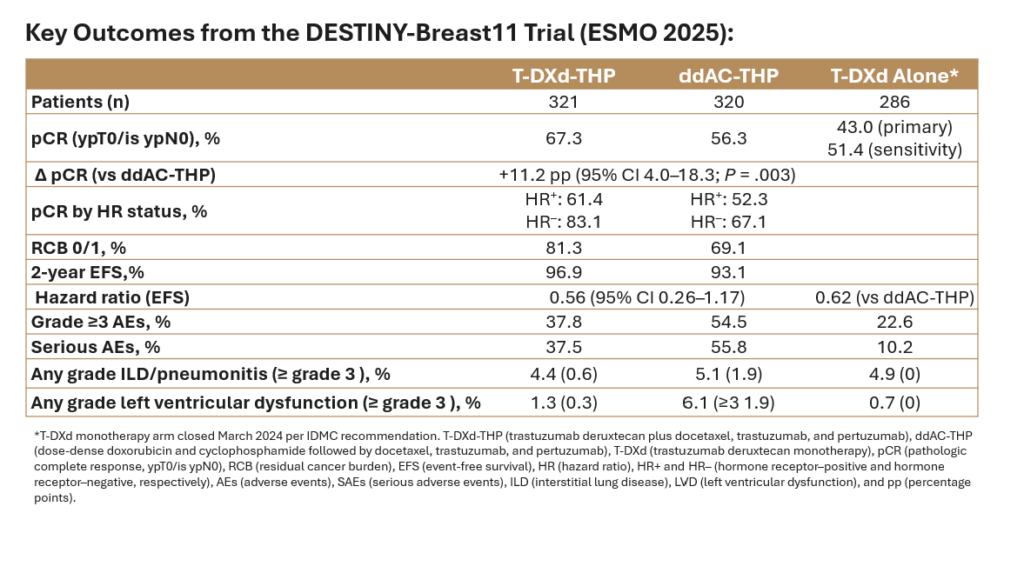
    The global, open-label phase 3 study randomized 927 patients with HER2-positive eBC to receive (1:1:1) trastuzumab deruxtecan plus docetaxel, trastuzumab, and pertuzumab (T-DXd-THP), dose-dense doxorubicin and cyclophosphamide followed by docetaxel, trastuzumab, and pertuzumab (ddAC-THP), or trastuzumab deruxtecan monotherapy (T-DXd). The primary endpoint of the study was pathologic complete response (pCR) by blinded central review, and key secondary endpoints included event-free survival (EFS), invasive disease-free survival (iDFS), overall survival (OS), and safety.

    Median patient age was 50 years, 73% were hormone receptor (HR)–positive, and 89% had node-positive disease.

    The trial met its primary endpoint with T-DXd-THP achieving a pCR rate of 67.3% compared with 56.3% with ddAC-THP, an absolute difference of 11.2 percentage points (95% CI 4.0–18.3; P = .003). The benefit was observed in both HR-positive and HR-negative groups and independent of menopausal or HER2 status (IHC3+ vs other) status.

    Residual cancer burden (RCB) analyses echoed this finding: 81.3% of patients on T-DXd-THP had RCB 0/1, compared with 69.1% in the control arm.

    Event-free survival data were immature at the time of analysis but trended in favor of T-DXd-THP (HR, 0.56; 95% CI, 0.26–1.17). T-DXd monotherapy showed inferior EFS compared to ddAC-THP and was closed on March 13, 2024, as recommended by the independent data monitoring committee.

    Treatment with T-DXd-containing regimens resulted in fewer grade 3 or higher adverse events (AEs), lower hematologic toxicity, fewer treatment interruptions, and less left-ventricular dysfunction. The incidence of interstitial lung disease (ILD) was comparable between arms. T-DXd-THP treatment resulted in higher rates of nausea but were similar for other gastrointestinal toxicities. Adverse events leading to surgical delay occurred in 3.4% of T-DXd-THP patients vs 2.6% of those receiving ddAC-THP.

    Overall, the DESTINY-Breast11study showed that the combination of T-DXd with THP resulted in the highest pCR rates for a registrational trial to date with lower toxicity for patients with HER2+ eBC and may redefine the neoadjuvant standard for high-risk HER2-positive eBC, but longer-term outcomes are awaited. The study was published simultaneously to presentation in the Annals of Oncology.

    References

    Harbeck N, et al. Trastuzumab deruxtecan–based neoadjuvant therapy in high-risk HER2-positive early breast cancer. Abstract 291O, presented at: ESMO 2025 Congress; October 2025; Barcelona, Spain.

    Harbeck N, Modi S, Pusztai L, et al. Neoadjuvant trastuzumab deruxtecan alone or followed by paclitaxel, trastuzumab, and pertuzumab for high-risk HER2-positive early breast cancer (DESTINY-Breast11): a randomised, open-label, multicentre, phase 3 trial.

  • Four-Year Median OS with Osimertinib/ Chemotherapy Combination in Advanced EGFR-Mutation Positive NSCLC

    he final overall survival (OS) analysis from the FLAURA2 trial was presented during the International Association for the Study of Lung Cancer (IASLC) 2025 World Conference on Lung Cancer (WCLC) Presidential Symposium, firmly establishing osimertinib plus chemotherapy as a new first-line standard for patients with advanced epidermal growth factor receptor (EGFR)-mutated non–small cell lung cancer (NSCLC). The final OS analysis showed the longest survival yet reported in this population from a global phase 3 trial.

    FLAURA2 enrolled 557 patients with untreated, locally advanced or metastatic EGFR exon 19 deletion or L858R NSCLC. Patients with stable brain metastases were allowed on study. Participants were randomized to receive osimertinib with carboplatin or cisplatin plus pemetrexed for four cycles followed by maintenance osimertinib–pemetrexed, or osimertinib monotherapy at 80 mg daily. Treatment beyond progression was permitted if investigators judged clinical benefit. Subsequent therapy was at investigator discretion. Progression-free survival (PFS) was the primary endpoint, and OS was a key secondary endpoint.

    At the primary PFS analysis (data cut April 2023), the addition of chemotherapy reduced the risk of progression by 38% (HR 0.62; 95% CI 0.49–0.79; p<0.001), with median PFS of 25.5 months versus 16.7 months for osimertinib alone. These benefits were consistent across prespecified subgroups, including patients with brain metastases and those harboring L858R mutations.

    With extended follow-up to June 2025 (57% maturity), median OS reached 47.5 months in the osimertinib–chemotherapy arm compared with 37.6 months with osimertinib monotherapy (HR 0.77; 95% CI 0.61–0.96; p=0.02). Three-year OS was 63% versus 51%, respectively. The OS advantage was maintained across all predefined subgroups.

    Median osimertinib exposure was 30.5 months with the combination, versus 21.2 months with monotherapy. The median pemetrexed exposure in the experimental arm was 8.3 months, suggesting many patients experienced a prolonged chemotherapy-free interval.

    Patterns of subsequent therapy highlighted clinical practice implications. After progression, platinum-based chemotherapy was the most common second-line treatment in both arms, given to 44% of patients in the combination arm and 72% after osimertinib alone. Importantly, the OS benefit for the upfront combination was preserved despite widespread use of platinum rechallenge after monotherapy.

    Grade ≥3 adverse events (AEs) were more common with the combination (70% vs 34%). Anemia, diarrhea, nausea, and decreased appetite were the most common any-grade AEs.  Adverse events led to discontinuation of osimertinib in 12% of patients in the combination arm and 7% with monotherapy. No new safety signals or treatment-related deaths emerged during longer follow-up.

    These findings build on the FLAURA2 PFS advantage and confirm clinically meaningful OS improvement. Median OS of nearly four years represents the longest survival reported for EGFR-mutated NSCLC in a phase 3 global study. With compelling evidence across subgroups and no excess late toxicity, osimertinib plus chemotherapy is now firmly positioned as the frontline standard of care for EGFR-mutated advanced NSCLC.

    References

    Planchard D, Jänne PA, Kobayashi K, et al. First-line osimertinib plus chemotherapy versus osimertinib monotherapy in EGFR-mutated advanced NSCLC: FLAURA2 final overall survival. Presented at: IASLC World Conference on Lung Cancer (WCLC) 2025; September 7, 2025; Barcelona, Spain. Abstract PL01.06.

  • FDA Approves Sunvozertinib for EGFR Exon 20 Insertion-Positive Metastatic NSCLC

    On July 2, 2025, the U.S. Food and Drug Administration (FDA) granted accelerated approval to sunvozertinib for patients with locally advanced or metastatic non-small cell lung cancer (NSCLC) harboring epidermal growth factor receptor (EGFR) exon 20 insertion mutations, (as detected by an FDA-approved test), whose disease has progressed on or after platinum-based chemotherapy.

    Sunvozertinib is an oral EGFR tyrosine kinase inhibitor. The approval was based on the phase WU-KONG6 multicenter study evaluating sunvozertinib monotherapy in patients with previously treated EGFR exon 20 insertion–positive NSCLC. The objective response rate was 46% with a median duration of response of 11.1 months.

    US Food and Drug website. Available at: https://www.fda.gov/drugs/resources-information-approved-drugs/fda-grants-accelerated-approval-sunvozertinib-metastatic-non-small-cell-lung-cancer-egfr-exon-20. Accessed July 9, 2025.